
Stop technology getting in the way of your people
See where time is being lost, find problems people never report and remove the digital friction affecting productivity and employee experience.
Your systems can be working while your people are struggling
A green dashboard tells you that technology is available. It doesn’t tell you whether someone is waiting for an application to load, fighting with an unreliable device or working around the same problem for the third time that week.
Digital Experience Management gives you visibility into what people actually experience when they use workplace technology.
It helps answer questions senior leaders should be able to answer:
- Where is technology costing us productive time?
- Which problems keep coming back?
- Where are people struggling without reporting it?
- Are devices and applications performing as they should?
- Where should IT focus improvement effort first?
- Are tech investments improving the experience they should?
The point is to see the friction that ordinary monitoring and ticket data can miss.
Book a DEX strategy session
The absence of tickets doesn’t mean the absence of problems
Most people don’t report every technology problem. They wait, restart, find another route, put up with a slow application, move to a different device, ask a colleague. Or try again later. The work still gets done, but it takes longer.
DEX gives IT another view, using experience data to identify performance problems and recurring patterns even when nobody has raised a support ticket.
DEX can support your organisation by helping you:
Slow devices
See where startup times, resource constraints and poor endpoint performance are affecting everyday work.
Application problems
Identify crashes, poor performance and recurring application issues that interrupt people throughout the day.
Collaboration friction
Understand where workplace tools and services are contributing to a poor or inconsistent user experience.
Recurring issues
Spot patterns across users and devices instead of waiting for the same problem to become another ticket.
That changes the conversation from “Is the system up?” to “Can people actually work effectively?”
What happens when DEX finds a problem?
Seeing the problem is only useful if you can do something about it.
Wanstor looks at who is affected, how often it happens and whether there is a known cause or repeatable fix. The response might be an automated action, problem-management work, a configuration change or a wider improvement to the technology environment.
For issues we’ve seen before, we can go further. Magic Table can turn an approved fix into a repeatable action, helping remove the usual cycle of troubleshooting, remote access and disruption.
1. Find it
DEX identifies where devices, applications and digital services are creating friction, including problems employees may never report.
3. Act on it
Known problems become approved fixes through Magic Table, while other issues move into problem management or improvement work.
2. Understand it
Service Intelligence looks for patterns and causes, separating isolated frustrations from issues affecting people more widely.
4. Check it worked
DEX measures the experience after the change, helping show whether the intervention made a meaningful difference.
DEX is part of something bigger at Wanstor
Wanstor doesn’t use DEX as another dashboard for IT to monitor. DEX shows us where technology is getting in people’s way. Service Intelligence helps us understand why, and Magic Table gives us a way to turn known problems into repeatable action.
Alongside our Service Desk, we bring together digital experience insight, problem management, AI, automation and continual improvement. SwanNow helps engineers get to the right answer faster, while Magic Table helps turn approved fixes into action.
The best support is the call you never need to make.
The goal isn’t simply to close tickets faster. It’s to prevent more of the disruption that creates them in the first place.
DEX can reveal problems employees tolerate or work around. Problem management helps us understand recurring causes. Magic Table can automate known fixes, while monitoring can increasingly trigger action before a customer experiences the failure.
Sector-aligned Service Desks
Our teams understand how technology disruption affects organisations differently across care, hospitality and professional services.
Digital experience insight
DEX shows what people experience on their devices, including performance problems that never become support tickets.
Problem management
Service and experience data help us find underlying causes instead of repeatedly dealing with the same symptoms.
Continual improvement
Service Intelligence works alongside our Service Desk to improve how problems are detected, resolved and prevented.
From insight to action
DEX becomes more powerful when the service supporting it can act on what it finds.
That’s why Wanstor has invested in its own automation and AI capabilities alongside digital experience insight.
Magic Table: shorten the distance from problem to fix
Magic Table is automation built by Wanstor to remove unnecessary effort from IT support.
When we understand a recurring problem, we can turn the known remedy into an approved, repeatable action. Engineers can trigger those actions through ServiceNow and, for many issues, apply the fix without arranging a remote session or asking someone to stop working.
Magic Table is already being used for device health, Microsoft 365 and application issues, performance problems, security actions and customer-specific fixes. Internally, those approved actions are surfaced through Smart Actions in ServiceNow.
And the model is developing further. Monitoring can already trigger preventative remediation in some scenarios, moving Wanstor closer to fixing problems before they become incidents.

Why that matters
People spend less time troubleshooting with IT, while Wanstor turns fixes we’ve already understood into actions we can use repeatedly and consistently.
500+
Magic Table runs each week
58 hours
Engineering time saved each week
74%
Reduction in backup failures following preventative VSS remediation
SwanNow: better information at the point of support
SwanNow is Wanstor’s AI assistant inside ServiceNow. It brings relevant knowledge, previous cases and customer context to engineers, helping them reach a better-informed answer faster while retaining human oversight.
Why that matters: less searching, fewer unnecessary hand-offs and a better-informed response.

Learn more from this brochure View brochure

Where is technology quietly costing your people time?
Employees shouldn't have to accept slow devices, recurring application problems and constant workarounds as part of the working day.
Book a DEX Strategy SessionDEX should improve something that matters
Before the service starts, we agree what you want DEX to change and how we’ll know whether it has worked.
That might mean reducing recurring technical issues, improving device or application experience, removing a particular source of digital friction or giving IT better evidence for investment decisions.
DEX Value Assurance
We agree:
What should improve
Define the problem or experience your organisation wants to change before measurement begins.
How we’ll measure it
Agree the evidence and measures we’ll use to establish the starting point and track progress.
What success looks like
Set clear success criteria so both sides know what a meaningful improvement actually means.
When we’ll review it
Agree the review point upfront, giving you a clear moment to assess whether DEX is delivering value.
Where DEX Value Assurance forms part of the agreement, customers may have the option to remove DEX from their contract at an agreed review point if the agreed success criteria are not met. Eligibility, measures, timings and contractual terms are agreed before the service begins.
You know what we’re trying to improve before you start paying us to improve it. Ask us about DEX Value Assurance.
What Digital Experience Management can change
The priority will be different for every organisation, but the themes are usually familiar.
Give people time back
Find delays, interruptions and recurring technology problems that quietly consume productive time during the working day.
Reduce repeat problems
Turn recurring issues into problem-management priorities and, where appropriate, approved automated fixes through Magic Table.
Find hidden problems
See experience issues employees tolerate or work around, including problems that never become Service Desk tickets.
Invest with evidence
Use real employee-experience data to inform decisions about devices, applications, services and wider technology investment.

Digital Experience Management for your sector
The same technology problem can have a very different business impact depending on who experiences it.
Sector |
Charities & NFP organisations |
Professional services |
Hospitality |
Real estate organisations |
Housing providers |
| What you get | Reduce technology friction for stretched teams, helping people spend less time working around IT problems and more time delivering services. | Protect valuable working time by finding the device, application and collaboration issues that interrupt client-facing and knowledge-intensive work. | Find technology problems across distributed locations before recurring device or application issues begin affecting employees, guests and day-to-day operations. | Improve experience across distributed teams, applications and devices while giving IT clearer evidence for priorities across complex technology environments. | Reduce recurring technology friction for office and frontline teams, helping employees stay productive while supporting residents and essential services. |
What DEX has quantified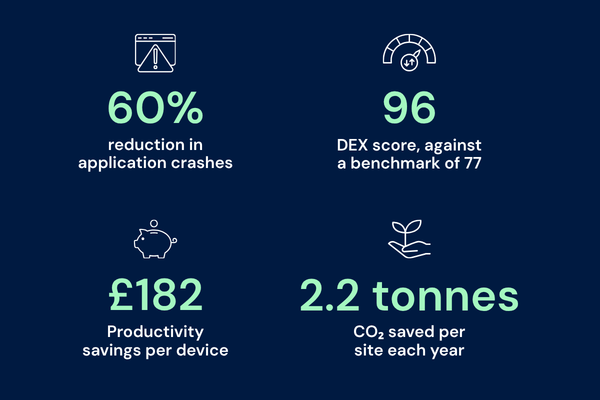
See DEX in the real world. Watch our customer case study.
Book a DEX strategy session
Tell us what you want to improve. We'll look at the experience you want to understand, the evidence available and how you could measure whether it changes.
Frequently Asked Questions
What is Digital Experience Management?
Digital Experience Management, or DEX, helps organisations understand how employees experience workplace technology across devices, applications and digital services. It can reveal performance problems, recurring issues and sources of digital friction that traditional infrastructure monitoring or support-ticket data may not show.
How do I know if technology is affecting employee productivity?
Look for slow devices, unreliable applications, repeated interruptions, poor collaboration-tool performance and workarounds that people have simply learned to tolerate. DEX gives IT evidence across devices, applications and the employee experience so you can see where technology is consuming time or making everyday work harder.
Why do employees have IT problems when our dashboards are green?
Infrastructure monitoring usually tells you whether technology is available and technically healthy. It may not show that an application is responding poorly on a particular employee’s device, that an endpoint is deteriorating or that somebody repeatedly experiences problems that never become a support ticket. DEX adds that user-experience view.
Can DEX identify problems employees don’t report?
Yes. One of the benefits of DEX is visibility into aspects of the technology experience that may never result in a support ticket. That can help IT investigate recurring friction affecting people who have adapted to a problem or don’t consider it serious enough to report.
What’s the difference between DEX and IT monitoring?
Traditional IT monitoring focuses primarily on infrastructure, availability and system health. DEX looks at how the technology actually performs for the person using it. Used together, they give IT a much more complete view of whether technology is both available and effective.
What happens after DEX identifies a problem?
Wanstor looks at who is affected, how often the issue occurs and what action is appropriate. Depending on the cause, the response could involve automation, problem management, a configuration change, device remediation or another service improvement. We can then measure whether the change improved the experience.
Can DEX work with a managed IT service?
Yes. This is where DEX can become particularly valuable. Wanstor uses digital experience insight within its wider Service Intelligence approach, alongside Service Desk expertise, problem management, automation, AI and continuous service improvement.
How does Wanstor measure whether DEX is working?
We agree the outcome, relevant measures, success criteria and review points before the service begins. That gives both sides a defined starting point and a clear basis for determining whether the targeted experience has improved.
Where can I learn more about DEX?
Watch our on-demand webinar with Land Use Consultants on closing the user experience gap and implementing DEX in a live environment.
Does Wanstor guarantee DEX outcomes?
Wanstor’s DEX Value Assurance creates commercial accountability around the outcomes agreed with the customer. Where included in the agreement, customers may have the option to remove DEX at an agreed review point if the agreed success criteria have not been achieved. Eligibility and contractual terms are agreed before the service starts.